

[Video Duration: 12:45]
[Host: Expert Researcher at WeightLossChems]
[Tone: Professional, Energetic, Friendly]
0:00 – Introduction: The Precision Protocol
[On-screen: Host standing in a high-tech lab setting. Behind them, a digital screen glows with molecular structures of GLP-1 and BPC-157.]
Host: Hi Mate! Welcome back to the WeightLossChems research suite. If you’re here, you’re not just looking for "okay" results: you’re looking to revolutionize your metabolic health and unlock the full potential of your research.
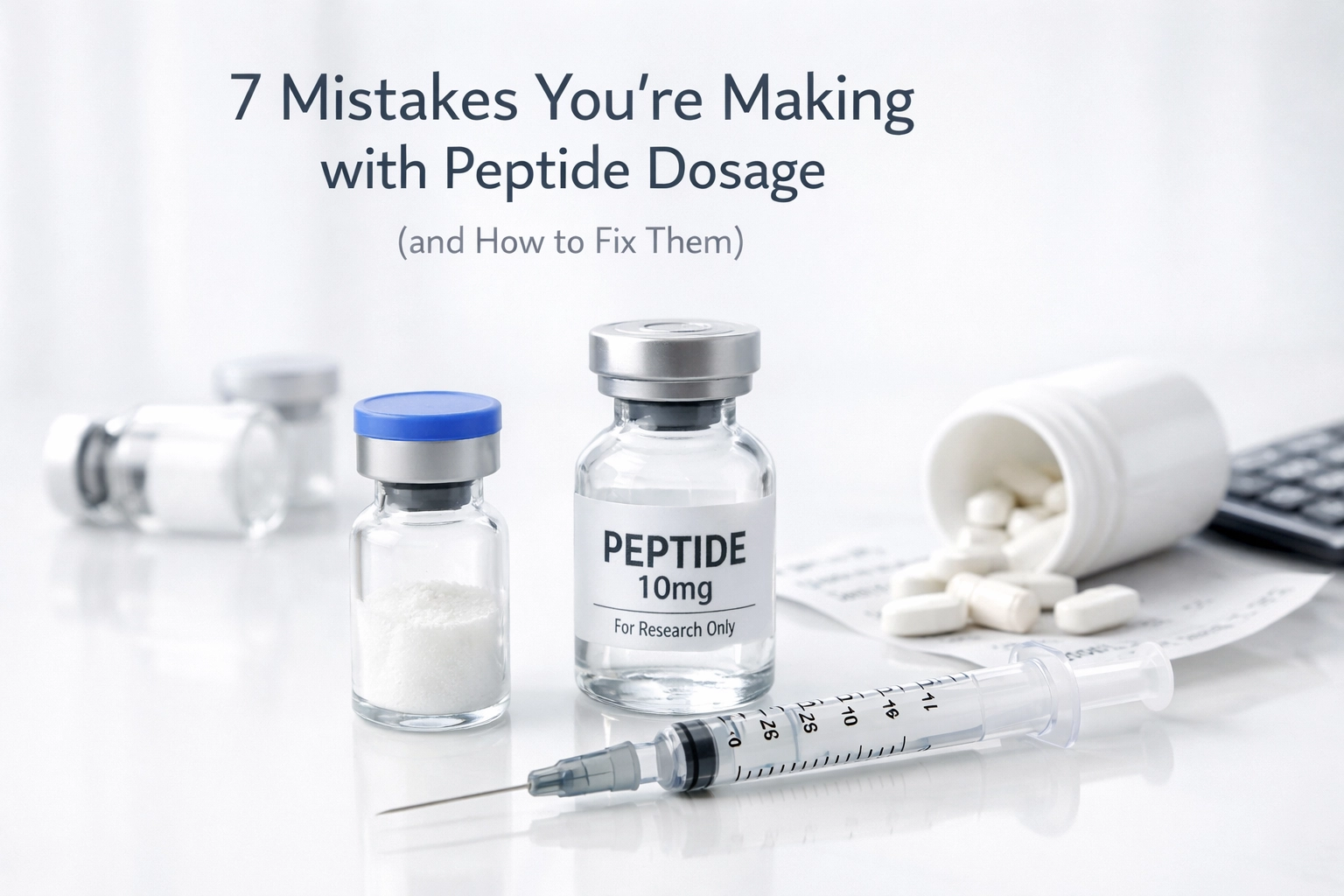
But here’s the cold, hard truth: even the highest-grade research peptides won’t do a thing if your protocol is off. In fact, most researchers fail before they even start because of basic dosing errors. Today, we’re breaking down the 7 biggest mistakes people make with peptide dosage and giving you the exact blueprint to fix them. We’re talking about moving from guesswork to scientific luxury.
Let’s dive in.
1:15 – Mistake #1: The "Budget" Trap (Sourcing Low-Quality Purity)
[On-screen: Text overlay "MISTAKE #1: UNVERIFIED SOURCING"]
Host: It starts with the vial. A lot of researchers try to save a few bucks by going with unverified vendors. Here’s the danger: research has shown that some of these "discount" peptides contain as little as 30% of the active ingredient.
If your vial says 5mg but only contains 1.5mg, your entire calculation is dead on arrival. You think you’re dosing a specific metabolic pathway, but you’re actually just injecting expensive Bac Water.
The Fix: Always demand third-party testing. At WeightLossChems, we prioritize "Scientific Luxury": meaning every batch is verified for purity and potency. Don’t gamble with your research. Ensure your starting point is 99% purity so your math actually means something.

2:45 – Mistake #2: The "Fear Factor" (Under-Dosing Below the MET)
[On-screen: Graphic showing a "Minimum Effective Threshold" (MET) line chart.]
Host: Mistake number two is being too cautious. We get it: you want to be safe. But there is something called the Minimum Effective Threshold (MET). If you’re researching BPC-157 for tissue repair and you’re only using 50mcg once a day because you’re nervous, you might as well be using nothing.
You’re spending the money and doing the work, but you’re not hitting the biological "on-switch."
The Fix: Research established, evidence-based protocols. For most tissue repair peptides, the data points to 250mcg to 500mcg twice daily. Don’t let fear stall your progress. Follow the science, hit the MET, and watch the transformation happen.
4:10 – Mistake #3: The "More is Better" Fallacy (Over-Dosing and Side Effects)
[On-screen: Host holding a 31g insulin syringe, pointing to the units.]
Host: On the flip side, we have the "Mega-Dosers." More is NOT always better. Peptides are precision instruments, not blunt force tools. If you blast your system with 10x the recommended dose of a GHRH/GHRP stack, you aren’t going to get 10x the muscle growth. You’re just going to get 10x the side effects: water retention, tingling, and potentially desensitizing your receptors.
The Fix: Stick to the "Goldilocks Zone." Peptide therapy is about bio-optimization, not biological overwhelm. If the protocol calls for 100mcg, stay at 100mcg. Precision is the ultimate flex in the research world.

5:55 – Mistake #4: Inconsistent Biological Signaling
[On-screen: A clock ticking rapidly, then slowing down. Text: "HALF-LIFE MATTERS"]
Host: Consistency is where most people drop the ball. Many peptides have incredibly short half-lives. If you’re inconsistent: skipping days or injecting at 8 AM one day and 4 PM the next: you’re disrupting the biological signal. Your body needs a steady pulse to trigger those metabolic pathways.
The Fix: Set a schedule and treat it like a VIP appointment. Use phone alarms or tracking apps. If you’re on a twice-daily protocol, aim for a 10-12 hour gap. This keeps the peptide concentration at therapeutic levels, ensuring your research yields the data you actually want.
7:30 – Mistake #5: Flying Solo (No Professional Guidance)
[On-screen: Host sitting at a desk with a laptop, looking at a "Peptide Protocol" document.]
Host: Look, we love the DIY spirit of the research community, but ignoring medical guidance is a massive mistake. Your unique health markers: your blood work, your current medications, your specific goals: all dictate how a peptide will interact with your system.
The Fix: Consult with a qualified professional. Whether it's a doctor trained in peptide therapy or a specialist who understands "Triple Agonists" and "Metabolic Switches," having a pro in your corner ensures your research is both safe and effective. It’s the difference between a random experiment and a structured journey toward longevity.

9:15 – Mistake #6: The "Kitchen Sink" Stack (Zero Tracking)
[On-screen: Graphic of five different peptide vials labeled: BPC-157, TB-500, Ipamorelin, CJC-1295, and AOD-9604.]
Host: We see this all the time. A researcher gets excited and starts a "Kitchen Sink" stack: five peptides at once. Then, when they feel great (or feel terrible), they have no idea which peptide is responsible. You can’t optimize what you can’t measure.
The Fix: Keep it simple, mate. If you’re new, start with one or two peptides. If you do stack, keep a detailed log. Track your energy, your recovery, and your sleep. Use objective data, not just "vibes." This is how you unlock the true power of your "Exclusive Drops."
10:45 – Mistake #7: The "Math Meltdown" (Mg vs. Mcg Confusion)
[On-screen: Host pointing to the WeightLossChems logo and a "Peptide Calculator" icon.]
Host: This is the big one. The mistake that causes the most stress. Unit Confusion.
Is it 5mg? Is it 500mcg? How many units on a 100-unit syringe? If you mix 2ml of Bac Water into a 5mg vial, how much do you pull for a 250mcg dose?
If your brain is hurting just hearing that, you aren’t alone. Miscalculating your reconstitution math can lead to doses that are 10x too high or 10x too low.
The Fix: Stop the manual math and use the WeightLossChems Peptide Dosage Calculator.
[On-screen: Screen recording of the Peptide Calculator tool being used.]
It’s simple:
- Input the amount of peptide in the vial (e.g., 5mg).
- Input the amount of bacteriostatic water you added (e.g., 2ml).
- Input your desired dose (e.g., 250mcg).
- The tool tells you exactly how many units to pull into your syringe.
No more guessing. No more stress. Just pure, scientific accuracy.

12:00 – Conclusion: Join the VIP Research Community
[On-screen: Host walking toward the camera, looking determined.]
Host: Researching peptides is one of the most exciting ways to revolutionize your health and combat the effects of aging and metabolic slowdown. But you have to do it right. Avoid these seven mistakes, use our calculator, and prioritize quality above all else.
Ready to take your research to the next level? Join our VIP Club for exclusive drops, deep-dive guides, and the highest-grade research materials on the market.
Hit that link in our bio to access the Peptide Dosage Calculator and browse our latest batch of high-purity research peptides.
Host: Stay precise, stay informed, and let’s transform those results. See you in the next video, Mate!
[On-screen: WeightLossChems Logo with "Precision. Purity. Performance." text.]
[Video Ends]