
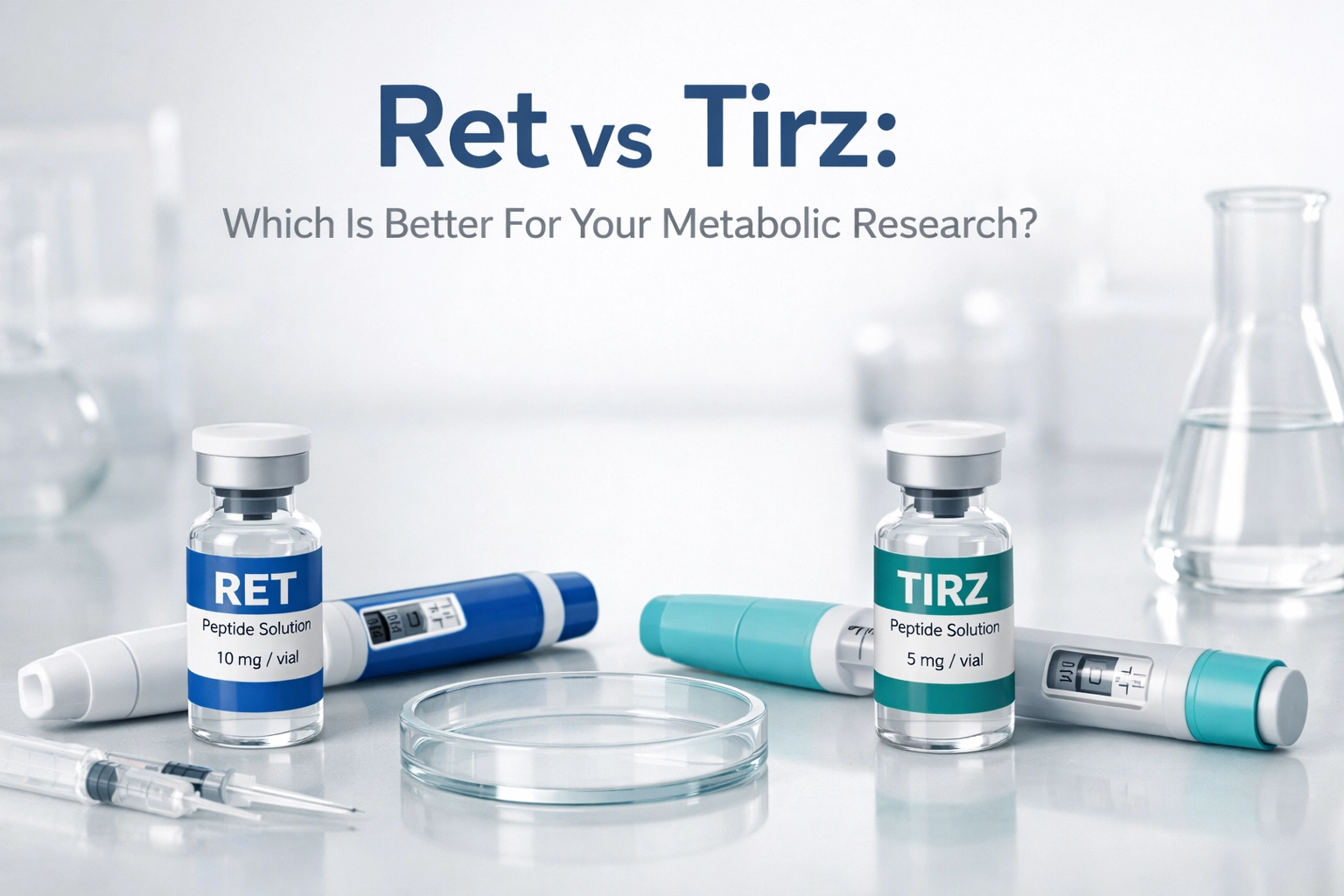

Hi Mate! Welcome back to the WeightLossChems lab blog. If you’ve been following the breakneck speed of metabolic science lately, you know we are living in a golden age of bio-optimization. Today, we’re diving deep into the ultimate heavyweight battle: Ret vs Tirz.
Whether you are looking to Unlock new pathways in cellular energy or Transform the way your research subjects handle glucose, choosing between these two titans is the most critical decision you’ll make this quarter. We’re talking about the difference between a high-performance dual-engine and a next-gen triple-hybrid powerhouse.
Let’s break down the data, the mechanisms, and the "scientific luxury" that these research peptides bring to your bench.
The Evolution of the Metabolic Switch
For years, the gold standard in research peptides for weight loss was the single-pathway GLP-1 agonist. Then came Tirz, the dual-agonist that changed the game by adding GIP into the mix. But just as we were getting comfortable, Ret entered the scene, the world’s first "triple agonist."
Before we get into the nitty-gritty, check out this quick visual breakdown of how these molecules interact with the body's master switches.
Tirz: The Established Dual-Agonist Powerhouse
Tirz (the shorthand we use for the dual GLP-1 and GIP receptor agonist) has been the reigning champion for a reason. By targeting two distinct pathways, it provides a synergistic effect that single-pathway research materials simply can't match.
The Functional Profile:
- Classification: Dual GLP-1 (Glucagon-like peptide-1) and GIP (Glucose-dependent insulinotropic polypeptide) Receptor Agonist.
- Physical Contents: Lyophilized powder, typically in 5mg or 10mg vials, requiring reconstitution with Bacteriostatic Water.
- Primary Action: Enhances insulin secretion while suppressing glucagon, leading to superior glycemic control and delayed gastric emptying.
In research settings, Tirz has shown a remarkable ability to regulate appetite. Because it hits the GIP receptor, it often results in fewer "crashes" compared to older generations of metabolic research peptides. It’s the "reliable luxury sedan" of the peptide world, smooth, effective, and backed by a mountain of clinical data.

Ret: The Triple-Agonist Challenger
If Tirz is a luxury sedan, Ret is the experimental hypercar. Ret (short for the triple agonist targeting GLP-1, GIP, and the Glucagon receptor) is currently the most potent metabolic research peptide under investigation.
What makes it different? The Glucagon receptor agonism.
While GLP-1 and GIP focus on insulin and appetite, the addition of the Glucagon pathway in Ret helps to Revolutionize energy expenditure. It essentially tells the body to burn more fuel while simultaneously telling it to eat less. This "triple threat" is why researchers are seeing unprecedented numbers in body mass reduction studies.
The Scientific Function:
- GLP-1: Appetite suppression and glucose regulation.
- GIP: Metabolic efficiency and fat cell signaling.
- Glucagon: Increased thermogenesis and energy expenditure.
Head-to-Head: The Weight Loss Numbers
When we look at the clinical data for these research peptides for weight loss, the results are staggering.
- Tirz Efficacy: In 72-week studies, subjects typically showed a 15-21% reduction in total body mass.
- Ret Efficacy: Early-stage human trials (Phase 2) have shown Ret hitting approximately 18% weight reduction at only 24 weeks, climbing to a mind-blowing 24% at 48 weeks.
For researchers aiming to Combat extreme metabolic resistance, Ret appears to be the more potent tool. However, potency always comes with a trade-off.

Muscle Preservation: The Longevity Factor
One of the biggest concerns in metabolic research is the loss of lean muscle mass alongside adipose tissue. This is where "scientific luxury" meets biological reality.
In comparative studies, Ret has shown a slight edge in Muscle Mass Retention. Data suggests Ret maintains muscle at roughly 94.2% of baseline, while Tirz sits slightly lower at 92.8%. While the difference seems small, in the world of high-end research and bio-optimization, that 1.4% margin is significant for maintaining basal metabolic rate and long-term vitality.
Side Effect Profiles: What to Watch For
No elite research protocol is without its hurdles. When you Unlock these powerful pathways, the biological system will react.
- GI Issues: Tirz actually has a slightly higher incidence of gastrointestinal distress (20-26%) compared to Ret (14-18%).
- Heart Rate & Fatigue: This is where Ret shows its potency. Because of the Glucagon agonism, Ret researchers have noted a higher incidence of increased heart rate and fatigue (8-12%) compared to Tirz (5-9%).
If your research focus is on "comfort and compliance," Tirz might be your go-to. If you are looking for "maximum metabolic throughput," Ret is the undisputed king, provided you account for the increased energy demands on the subject.

Research Protocols: Reconstitution and Storage
To get the most out of these "VIP Club" tier peptides, your lab technique must be flawless.
Utilitarian Instructions for Peptide Handling:
- Temperature: Store your lyophilized vials in a cool, dark place (refrigeration at 2-8°C is preferred).
- Reconstitution: Use sterile Bacteriostatic Water (Bac Water). Aim for a 1ml or 2ml dilution depending on your desired concentration.
- The Gentle Swirl: Never shake the vial. These amino acid chains are delicate. Swirl gently until the solution is clear.
- Storage Post-Mixing: Once reconstituted, these peptides are far more fragile. Keep them refrigerated and use within 30 days for maximum potency.
Which One Is Right For Your Lab?
Choosing between retatrutide vs tirzepatide depends on your specific research goals.
- Choose Tirz if: You want a well-documented, reliable dual-agonist with a primary focus on appetite regulation and steady, proven results. It is the "Gold Standard" for a reason.
- Choose Ret if: You are investigating the "Triple Agonist" frontier. If your goal is to study the maximum possible impact on energy expenditure and rapid metabolic shifts, Ret is the high-tech solution you’ve been waiting for.
Join the WeightLossChems Elite
Research is moving fast, mate. Staying ahead of the curve means having access to the purest materials and the latest data. At WeightLossChems, we don't just provide peptides; we provide the tools to Revolutionize your understanding of human biology.
Want to get ahead of the next big drop? Join our VIP Club for exclusive access to new batches of Ret, Tirz, and other next-gen metabolic modulators. Our community of researchers is growing, and we want you at the forefront.

Final Thoughts for the Week
Whether you’re team "Dual" or team "Triple," the science is clear: we have never had more control over metabolic signaling than we do right now. Ret vs Tirz isn't just a comparison of two chemicals; it’s a comparison of two different philosophies of bio-optimization.
Ready to start your next protocol? Head over to our shop and grab the supplies you need to Unlock the next level of your research.
Stay sharp, stay scientific, and let's get those results!
, The WeightLossChems Team
Disclaimer: All products mentioned are intended for laboratory research purposes only. Not for human consumption. Please adhere to all local laws and regulations regarding the handling of research peptides.