
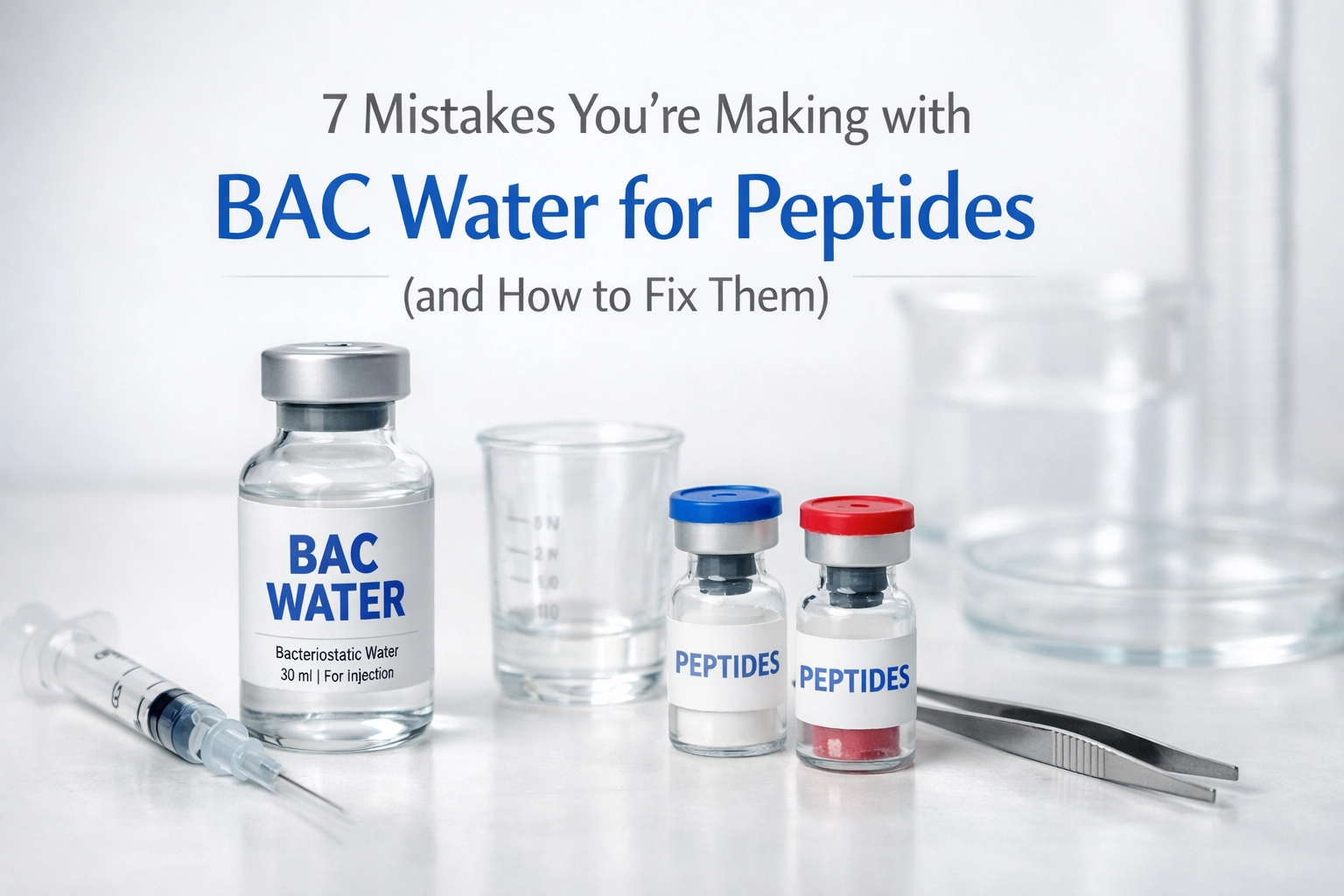
7 Mistakes You’re Making with BAC Water for Peptides (and How to Fix Them)

Hi Mate! Welcome back to the WeightLossChems lab. If you’re here, you’re clearly someone who values precision, science, and the absolute pursuit of metabolic excellence. You aren’t just looking for "results", you’re looking to Unlock the full potential of your research.
But here’s the cold, hard truth: even the highest-grade peptides, like our revolutionary Retatrutide or Tirzepatide, are only as good as the solvent you use to bring them to life. You could have the most advanced triple-agonist compound in the world, but if your reconstitution game is weak, you’re basically pouring your research budget down the drain.
Today, we’re diving deep into the unsung hero of the research world: Bacteriostatic (BAC) Water. It’s the lifeblood of your vials, yet it’s where 90% of researchers make critical, potency-killing mistakes.
Let’s fix that. Here are the 7 most common mistakes people make with BAC water and exactly how to optimize your protocol for maximum scientific impact.
1. The "Tap Water" Tragedy (Using the Wrong Solvent)
We get it. You’re in a hurry to Transform your research. You see a vial of powder, and you think, "It just needs to be wet, right?"
Wrong.
Using tap water, bottled mineral water, or even standard sterile water for a multi-use vial is a one-way ticket to a contaminated experiment. Regular water lacks the preservative power to stop microbial growth.
The Fix: You must use high-quality BAC Water. Why? Because our BAC water is a specialized preparation of sterile water containing 0.9% benzyl alcohol. This isn't just a fancy additive; it’s a bacteriostatic agent that inhibits the growth of bacteria, ensuring your research remains pure and your vials stay stable for weeks, not hours.
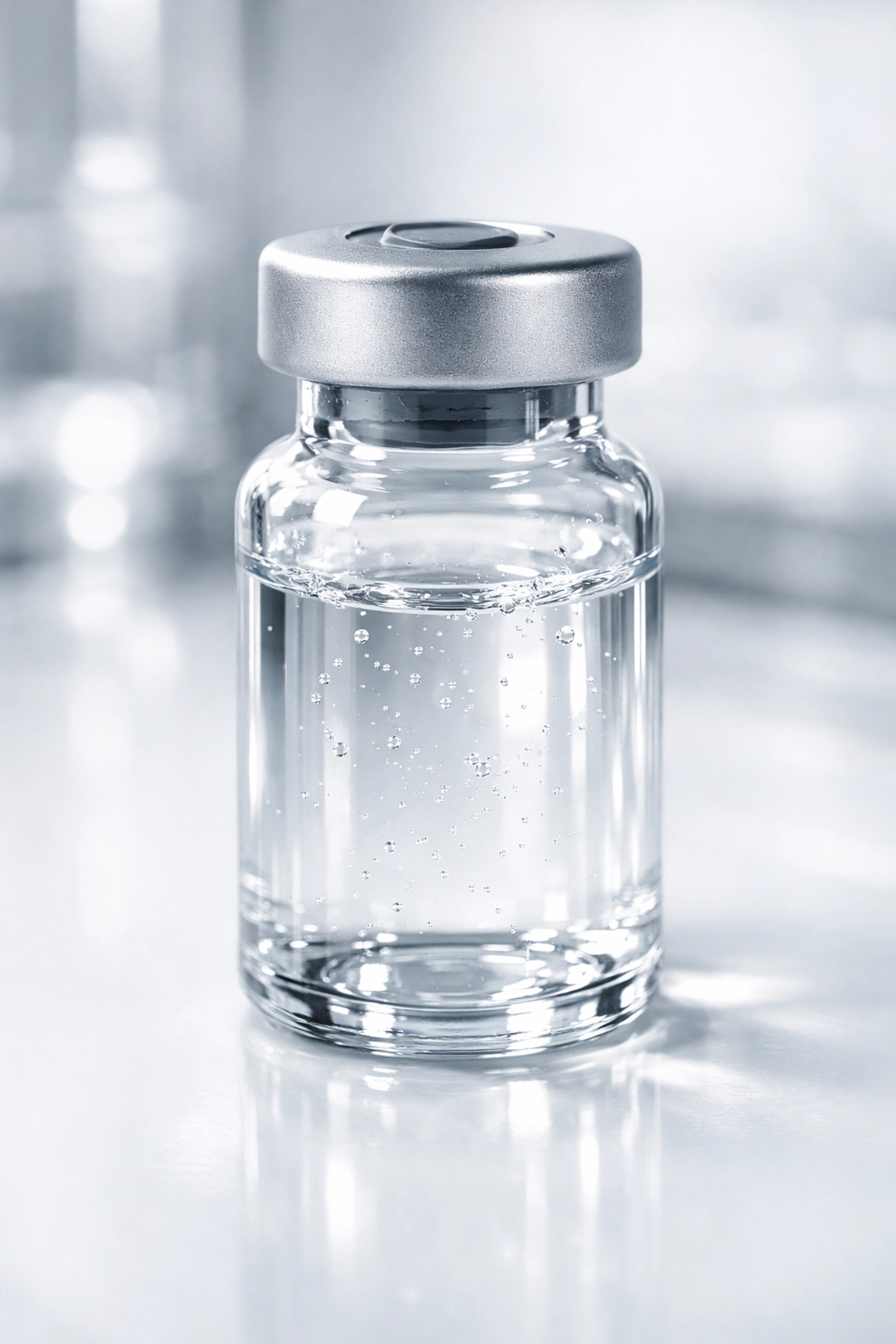
2. The "James Bond" Mistake: Shaking, Not Swirling
If there is one thing that makes a peptide chemist’s heart skip a beat (and not in a good way), it’s watching someone shake a vial like they’re making a martini.
Peptides are delicate, sophisticated chains of amino acids. They are held together by fragile bonds that are highly susceptible to "shearing forces." When you shake a vial, you aren’t just mixing; you’re physically tearing those molecular structures apart. This leads to proteolytic degradation, rendering your expensive research materials completely useless.
The Fix: Gentle is the name of the game. When you introduce the solvent, aim the needle at the side of the glass vial so the BAC water trickles down the wall. Once the water is in, gently swirl the vial in a circular motion.
Watch this video to see the professional reconstitution technique in action:
3. Thermal Shock: The Reconstitution Temperature Trap
Many researchers keep their peptides in the freezer (long-term) or the fridge (mid-term). A common mistake is pulling a vial straight out of the -20°C freezer and immediately blasting it with room-temperature BAC water.
This rapid temperature shift can cause "thermal shock," which can damage the crystalline structure of the lyophilized (freeze-dried) powder.
The Fix: Patience is a virtue in high-level research. Allow your peptide vial to reach room temperature naturally on the counter (usually about 15-20 minutes) before you even think about introducing the BAC water. This ensures the solubility is maximized and the molecular integrity remains intact.
4. Ignoring the "BAC-Incompatible" Rule
While BAC water is the gold standard for most research, it’s not a universal solvent. Some specific compounds actually degrade faster when exposed to benzyl alcohol.
Common research subjects like hCG, certain GLP-1 analogs (if specified by the manufacturer), or highly sensitive neuropeptides can sometimes react poorly to the preservative. While rare in the common weight loss peptide space, it’s a mistake that "novice" researchers make by assuming one solvent fits all.
The Fix: Always lead with the scientific classification. Check your specific peptide’s stability data. For the majority of our catalog, BAC Water is exactly what you need to Revolutionize your results, but always do your due diligence on new sequences.
5. The Math Headache: Dosing Confusion
This is where things get messy. You have a 5mg vial. You add 2ml of BAC water. How many mcg are in 10 units on an insulin syringe?
If your brain just short-circuited, you aren't alone. Miscalculating the ratio of solvent to solute is the #1 reason researchers fail to see the "Unlock" phase of their project. If you over-dilute, the concentration is too low; if you under-dilute, you risk inconsistent dosing.
The Fix: Don’t guess. Use a tool designed for the job. Our Peptide Calculator tool is the industry standard for precision. You simply plug in your vial size, the amount of BAC water added, and your target dose. It does the heavy lifting so you can focus on the science, not the arithmetic.
6. Contamination Through Re-using Needles
We’ve seen it all. In an effort to be "efficient," some researchers use the same needle to draw the BAC water and then go into multiple peptide vials.
Even if you think everything is "clean," the second that needle touches the rubber stopper of a vial or stays exposed to the air, it is no longer sterile. Introducing even a microscopic amount of "bio-burden" into your BAC water vial will eventually overcome the benzyl alcohol's preservative powers, turning your "Scientific Luxury" into a petri dish.
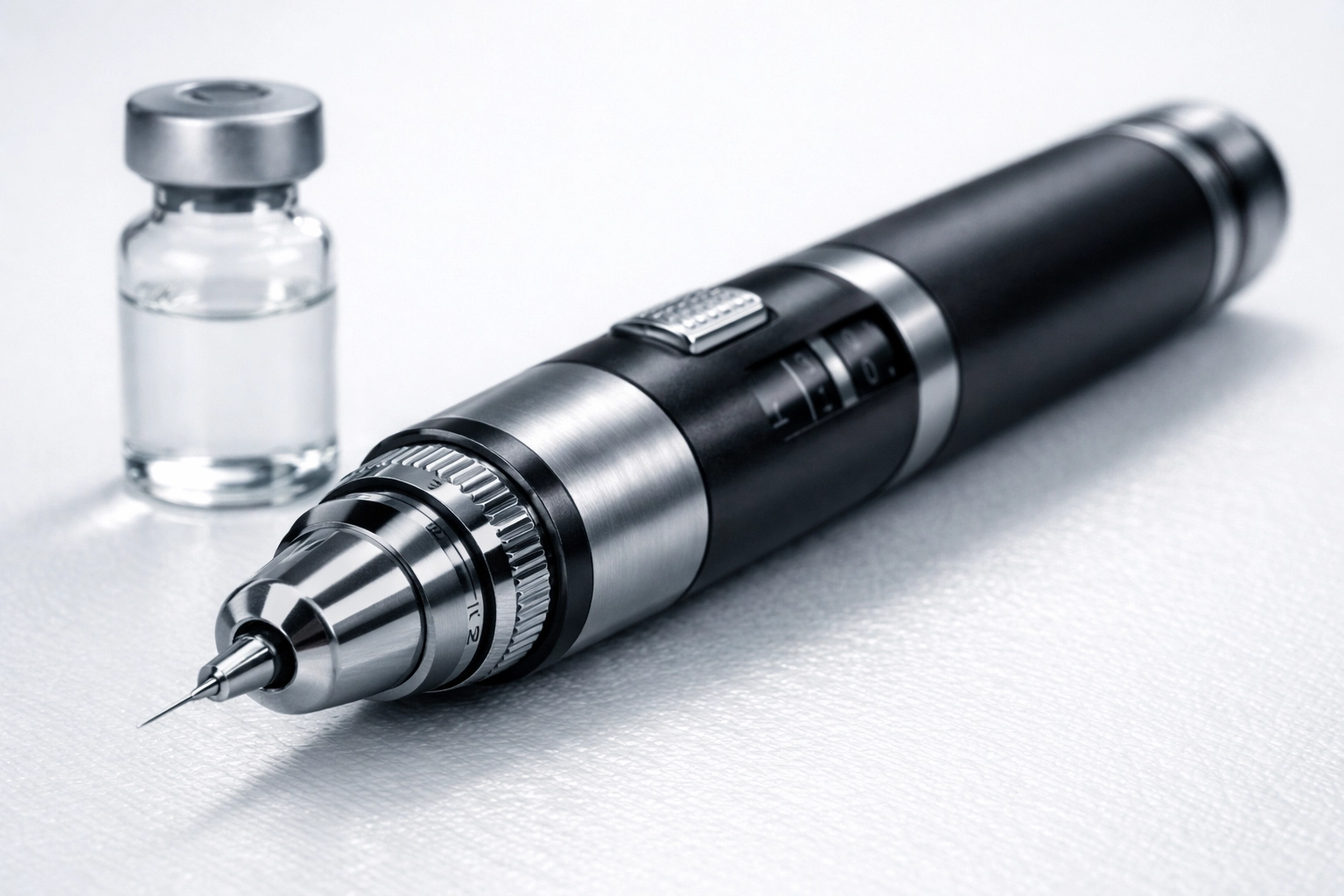
The Fix: One needle, one task. Use a fresh, sterile needle to draw your BAC water. If you are looking for the ultimate in precision and sterility for your research applications, consider upgrading to a Reusable Peptide Pen system. It’s the high-tech solution for researchers who demand the absolute best in delivery technology.
7. The "Set It and Forget It" Storage Error
"But Penny, it has a preservative in it!"
Yes, BAC water has a preservative, but that doesn't mean it’s invincible. Once a vial of BAC water is punctured, the clock starts ticking. Most manufacturers recommend discarding a punctured BAC water vial after 28 days. Furthermore, leaving reconstituted peptides on a warm sunlit windowsill is the fastest way to Combat your own progress. Light and heat are the enemies of peptide stability.
The Fix:
- Label your vials: Write the date of first puncture on your BAC water.
- Refrigerate: Once reconstituted, your peptides should live in the fridge (between 2°C and 8°C).
- Darkness: Keep them in the back of the fridge, away from the light of the door being opened.
The WeightLossChems Standard
Research isn't just about the molecules; it's about the methodology. When you choose to Transform your metabolic pathways, you need tools that are as serious as your goals.
By avoiding these 7 mistakes, you ensure that every microgram of your research material is working as hard as you are. Whether you are investigating the cutting-edge effects of triple agonists or refining your current metabolic protocol, the quality of your reconstitution determines the quality of your data.
Ready to level up your research?
- Secure your solvent: Shop High-Purity BAC Water
- Precision Delivery: Explore the Reusable Peptide Pen system
- Never Guess a Dose Again: Use the Peptide Calculator
Stay sharp, stay sterile, and keep pushing the boundaries of what’s possible. If you have questions or want to join the inner circle of researchers, keep an eye out for our Exclusive drops and VIP Club updates.
Happy researching, Mate!